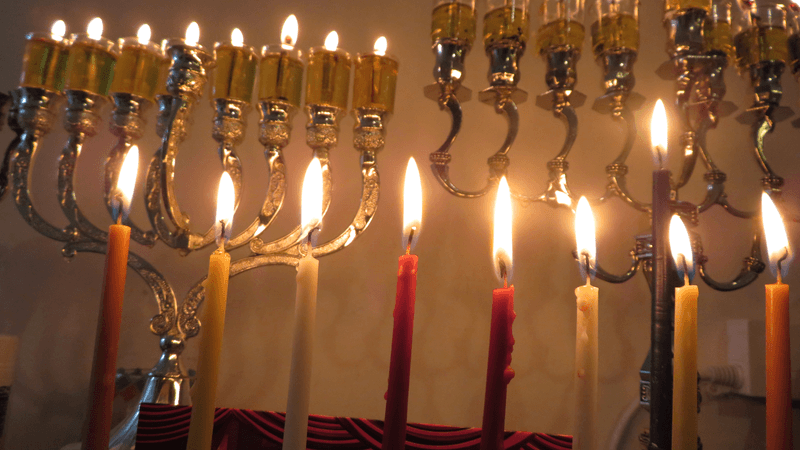
In 2026 Hanukkah (Chanukah) begins on Friday, December 4. The first candle is lit that afternoon, before Shabbat comes in. The eighth candle also falls on a Friday, December 11.
This guide follows the order of the evening: what to prepare, which oil to use, how to light, what changes on Friday, what about work, and an evening for the whole family. It describes the practice in Jewish homes and says where communities differ. It is not a halachic ruling; for a question about your own situation, ask your rabbi.
In short
- Eight nights: one candle on the first night, two on the second, up to eight. An extra candle, the shamash, stands apart.
- Any oil and any wick may be used. Olive oil is the preferred choice, and wax candles are a long-standing custom.
- The candles need to burn for at least half an hour from the time they are lit, and their light is not used for anything.
- On Friday the Chanukah candles come first and the Shabbat candles after them, both by your city's Shabbat candle-lighting time. On Friday they need more oil or longer candles.
- Going to work on Chanukah is permitted. Many refrain from chores while the candles burn.
The eight nights in 2026
- Friday, December 4: first candle, before the Shabbat candles
- Saturday night, December 5: second candle, after Shabbat ends
- Sunday, December 6: third candle
- Monday, December 7: fourth candle
- Tuesday, December 8: fifth candle
- Wednesday, December 9: sixth candle
- Thursday, December 10: seventh candle
- Friday, December 11: eighth candle, before the Shabbat candles
The eighth day ends at nightfall on Shabbat, December 12. This year Chanukah has two Shabbatot.
What you need, and which oil
A lamp. Eight lights in one row, at one height and not in a circle, so they do not look like one bonfire (Rema, Orach Chayim 671:4), and anyone who looks can count the nights. The shamash has its own place, usually higher or to the side.
Oil or candles. The Shulchan Aruch rules that all oils and all wicks are fit for Chanukah (673:1). The Rema adds that olive oil is the choicest way, because the miracle happened with it, as the Mishnah Berurah explains, and that wax candles became the custom because their light is clear. The Mishnah Berurah (673:4) prefers oil to wax. Whatever burns steadily for the needed time fits.
Enough to burn. At least half an hour (672:2). On Friday more is needed; see below.
The light is only for looking. One does not read or count money by it (673:1). That is why the shamash is added: if someone does use the light, it is the light of the shamash.
Where and when
The Talmud (Shabbat 21b) places the lamp at the entrance of the home, on the outside; someone who lives upstairs puts it in a window facing the street, and in a time of danger it is enough to set it on the table. All three are seen today: some light outside the door, many light in a window, and many light indoors by the door, opposite the mezuzah. The idea behind all of them is the same: to make the miracle known.
Customs also differ about the hour. Some light at sunset and others at nightfall (Mishnah Berurah 672:1). Someone who was delayed can still light later in the night, while the family is awake to see it. A night that was missed is not made up; the next night you light that night's number as usual (672:2).
Who lights
According to the Shulchan Aruch, one person lights for the household, and this is the custom of many Sephardic homes. The Rema writes that each member of the family lights, and this is the custom of most Ashkenazic homes (671:2). Women are obligated in Chanukah candles just as men are (675:3). Many give children a lamp of their own from the age when they begin to understand.
A guest can take part in the host's candles by contributing a small coin toward the cost, or light on their own (677:1). If you are travelling, ask in advance what your custom is.
Lighting, step by step
- Place the candles from right to left, as you face the lamp. The first night's candle is at the far right, and each night one is added to its left.
- Light the shamash.
- Say the blessings before lighting: three on the first night, and only the first two on the other nights (676:1-2).
- Light the newest candle first, the one at the left, and continue to the right (676:5).
- Hanerot Halalu is said once the lighting has begun or when it is done. Many sing Maoz Tzur, and some say Psalm 30, each according to their siddur.
- Stay near the candles for about half an hour. A candle that was lit properly and went out does not have to be lit again (673:2).
The blessings
Every night:
בָּרוּךְ אַתָּה יְהֹוָה אֱלֹהֵינוּ מֶלֶךְ הָעוֹלָם אֲשֶׁר קִדְּשָׁנוּ בְּמִצְוֹתָיו וְצִוָּנוּ לְהַדְלִיק נֵר חֲנֻכָּה:
Blessed are You, LORD our God, King of the universe who has sanctified us with His commandments and commanded us to light the Chanukah candles.
בָּרוּךְ אַתָּה יְהֹוָה אֱלֹהֵינוּ מֶלֶךְ הָעוֹלָם שֶׁעָשָׂה נִסִּים לַאֲבוֹתֵינוּ בַּיָּמִים הָהֵם בַּזְּמַן הַזֶּה:
Blessed are You, LORD our God, King of the universe who made miracles for our ancestors in their days in this season.
On the first night only:
בָּרוּךְ אַתָּה יְהֹוָה אֱלֹהֵינוּ מֶלֶךְ הָעוֹלָם שֶׁהֶחֱיָנוּ וְקִיְּמָנוּ וְהִגִּיעָנוּ לַזְּמַן הַזֶּה:
Blessed are You, LORD our God, King of the universe, who has kept us alive, sustained us, and brought us to this time.
The wording here follows the Siddur Sefard; say it as it is printed in your own siddur.
Friday, December 4 and 11: before Shabbat
- Prepare early. Set up the lamp on Friday at midday, with oil or candles that will burn from lighting until half an hour after the stars come out. Small colored candles are usually too short for this. If there is not enough for all, the Mishnah Berurah (679:2) asks that at least one of them should last that long.
- Not too early. Friday lighting begins only from plag hamincha, about an hour and a quarter (in seasonal hours) before nightfall (Mishnah Berurah 679:2); many calendars count it from sunset. Check the time in your city.
- Afternoon prayer. Where possible, Mincha is said before lighting.
- Chanukah first, then Shabbat. The Chanukah candles are lit with their blessings while it is still day, and the Shabbat candles after them, at your city's candle-lighting time (679:1). A woman who has already accepted Shabbat with her candles does not light the Chanukah candles afterwards; someone else in the home lights them.
- Once Shabbat is in, the lamp is not moved or relit. Put it where it can stay, away from curtains, drafts and children's hands.
On Saturday night the Chanukah candles wait until Shabbat is out. In the synagogue they are lit before Havdalah. At home some light first and others make Havdalah first, and both have a basis (Mishnah Berurah 681:3). Whoever lights at home before Havdalah first says the short formula "Baruch hamavdil bein kodesh lechol", "Blessed is the One who separates the holy from the ordinary" (Shulchan Aruch and Rema, Orach Chayim 299:10).
Work on Chanukah
Chanukah is not a day of rest like Shabbat. Work, school, cooking and driving are all permitted (670:1). What does exist is a custom, especially among women, not to do work while the candles are burning; some say this should not be treated lightly (670:1). The Mishnah Berurah mentions places where men keep it too, and counts it as about half an hour from lighting. Refraining from work for the whole day is something it discourages. Practices vary, so follow what is done in your family.
Eulogies and fasts are set aside on these days, which were fixed, in the Talmud's words, for praise and thanksgiving.
In prayer and in the synagogue
- Al HaNissim is added in the Amidah and in the Grace after Meals all eight days (682).
- The full Hallel is said every morning (683).
- Each day the Torah is read from the gifts of the tribal leaders in Numbers 7.
- Thursday and Friday, December 10 and 11, are Rosh Chodesh Tevet: Ya'aleh VeYavo is added, and the Torah reading is for Rosh Chodesh and for Chanukah (684:3).
- Shabbat, December 5: Parashat Vayeshev, with the haftara Zechariah 2:14 to 4:7, the prophet's vision of the golden menorah. Shabbat, December 12: Parashat Miketz, with the haftara I Kings 7:40-50, on the lamps Solomon made for the Temple.
A Chanukah evening for the family
Forty minutes, from the youngest to the oldest. It fits the time the candles burn.
1. Light together. Ask one child to count how many candles belong to tonight, and another to find the newest one.
2. One verse by the light of the room. Read it aloud, in Hebrew and in your own language:
כִּ֤י נֵ֣ר מִ֭צְוָה וְת֣וֹרָה א֑וֹר וְדֶ֥רֶךְ חַ֝יִּ֗ים תּוֹכְח֥וֹת מוּסָֽר׃
For the commandment is a lamp, and the teaching is light, And reproofs of instruction are the way of life;
Proverbs 6:23. The Talmud (Shabbat 23b) says that one who is careful with the lamp will have children who are scholars, and Rashi there connects it to this verse: through the lamp of the commandment comes the light of Torah.
3. The story, for children. When the Greeks came into the Temple, they made all its oil impure. When the Hasmoneans won, they searched and searched, and found only one small jug, sealed with the seal of the High Priest. There was enough oil in it to burn for one day. A miracle happened, and they lit from it for eight days. The next year the Sages fixed these days for praise and thanksgiving. So the Talmud tells it (Shabbat 21b).
4. Questions for the table.
- They could have waited until there was enough oil. Why do you think they lit what they had?
- Beit Hillel taught to add a candle every night. What in our home grows a little each day?
- The lamp is put where others can see it. Which good thing are you proud to show, and which do you prefer to do quietly?
- For what does each person at the table want to say thank you this week?
5. Dreidel. Everyone starts with the same number of coins, nuts or candies and puts one in the middle. Spin in turn. In the common rules, nun takes nothing, gimel takes everything, hei takes half, and shin puts one in. Outside Israel the letters stand for "a great miracle happened there"; in Israel the shin becomes a pei, "a great miracle happened here".
6. Something to eat. Foods fried in oil recall the oil. The Rema (670:2) also mentions a custom of eating cheese on Chanukah, and says that festive meals with songs and praise have something of a mitzvah in them.
For safety: a steady, fireproof base, long hair and sleeves tied back, and an adult in the room as long as a flame is burning.
Keep learning
Sources: Talmud Bavli, Shabbat 21b and 23b; Shulchan Aruch and Rema, Orach Chayim 670-684; Mishnah Berurah there. Blessings: Siddur Sefard. Photo: Chanukah candles by Breslevmeir, CC BY-SA 4.0, cropped.
