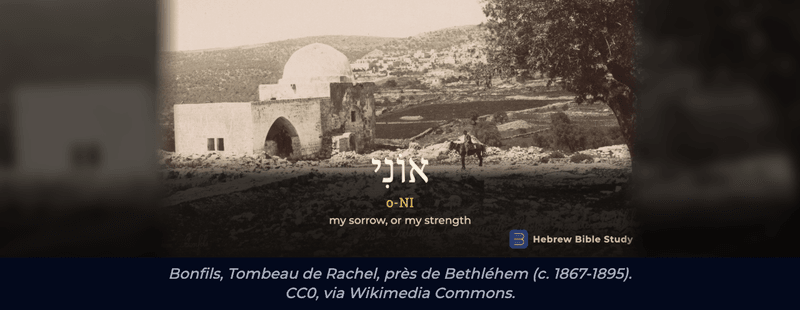
Rachel called his name Ben-oni.
Ramban finds a second meaning in it.
Read Genesis 35:18 in the free Hebrew Bible app: Hebrew audio, JPS English, dictionary and Rashi. Read Genesis 35:18 in Hebrew with audio, dictionary and Rashi
Rachel is in hard labour on the road to Ephrath when the midwife tells her, "Fear not; for this also is a son for thee" (Genesis 35:17). The next verse holds her last words, and they are a name: "she called his name Ben-oni; but his father called him Benjamin" (Genesis 35:18). Most translations, the app's JPS 1917 among them, leave her name in Hebrew. Rashi, the eleventh-century commentator, translates it as sorrow. Ramban, in the thirteenth century, finds a second meaning in it, and in that meaning the reason for the father's name.
וַתִּקְרָא שְׁמוֹ בֶּן־אוֹנִי
va-tik-RA she-MO ben o-NI
she called his name Ben-oni
Ben is son. Oni is the word to watch. Rashi: "בן אוני means SON OF MY SORROW", and the app's note names his source, the midrash Genesis Rabbah (82:9). Radak hears the birth itself: "for I gave birth to him in great pain". The dictionary in the app, Brown-Driver-Briggs, gives the same sense, "son of my sorrow", and has one place to cite: Ben-oni stands once in the whole Hebrew Bible.
Oni itself stands three times, and the other two pull apart. Before he dies, Jacob says to his eldest: "Reuben, thou art my first-born, My might, and the first-fruits of my strength" (Genesis 49:3). My strength is oni, letter for letter and vowel for vowel the word in Rachel's name. In Deuteronomy the farmer who has given his tithes declares, "I have not eaten thereof in my mourning" (Deuteronomy 26:14), and in my mourning is ve-oni, oni with a prefix. The app's Dictionary shows the same three root letters for both, א-ו-ן: on, "vigor, strength; wealth", and aven, "iniquity, wickedness; trouble, sorrow".
Ramban reads Rachel's verse with both senses open. His mother, he writes, meant "the son of my mourning", the oni of the tithe and of Hosea's "bread of mourners" (Hosea 9:4). "And his father understood the word oni in the sense of" strength, the oni of Reuben's blessing, and so he called the boy Binyamin, "the son of strength", "for in the right hand (yamin) there is strength and success". The app's entry for Benjamin has the plain form, "son of (the) right hand". So the father leaves the mother's word standing: "Jacob wanted to call him by the name his mother had called him", Ramban writes, "and he thus rendered it to good and to strength."
The app's English, by Charles B. Chavel, says rendered. Ramban's Hebrew verb is tirgem, the ordinary word for translating. On this reading the name Benjamin is a translation of Ben-oni: the same word, turned to its other meaning.
Where the word goes next
Rashi's own note on Benjamin goes another way: "he alone was born in the land of Canaan which is in the South", and yamin, the right hand, is also the south. The app's entry for yamin gives the reason, "because when facing east the right hand is toward the south". The app's Rashi adds a second reading, "son of his old days", and years later Judah describes the boy to Joseph in much the same terms: "a child of his old age, a little one" (Genesis 44:20).
Two of Ramban's proof texts show both senses in the plural. Isaiah says God increases strength "to him that hath no might" (Isaiah 40:29), and no might is ein onim. Hosea's "bread of mourners" is lechem onim: the same spelling, the other entry. The Hebrew gives one spelling and the reader has to choose, as Ramban's Jacob chose on the road to Ephrath.
See it in the app
In the app, open Genesis 35:18, tap the verse and choose Resources: Rashi's notes and Ramban's whole argument are free in the Commentary tab; Radak's notes are in the same list, for subscribers. For the name, open Genesis 42:4: its second word, Binyamin, is free in the Dictionary tab, with "son of (the) right hand" and Rachel's name for him inside the entry. The two entries behind oni are free where the word is among a verse's first three: Deuteronomy 26:14 for the mourning, Job 18:7 for the strength. And from the Questions tab you can ask Rabbi Ari about the verse; he answers with sources for study.
This week's episode of The Story in the Original follows Jacob to the night he wrestles until dawn: Why Did Jacob Wrestle With God? The Hebrew Answer.
Sorrow or strength: which meaning do you hear in Ben-oni?
Read Genesis 35:18 in the free Hebrew Bible app: Hebrew audio, JPS English, dictionary and Rashi. Read Genesis 35:18 in Hebrew with audio, dictionary and Rashi
Verses in the 1917 Jewish Publication Society translation; Rashi on Genesis in the English of M. Rosenbaum and A. M. Silbermann (1929-1934); Ramban in the English of Charles B. Chavel (1971-1976) and Radak in the English of Eliyahu Munk, as the Hebrew Bible app shows them. Dictionary: Brown-Driver-Briggs, as the app serves it.
Image: Bonfils, Tombeau de Rachel, près de Bethléhem (c. 1867-1895). CC0, via Wikimedia Commons.