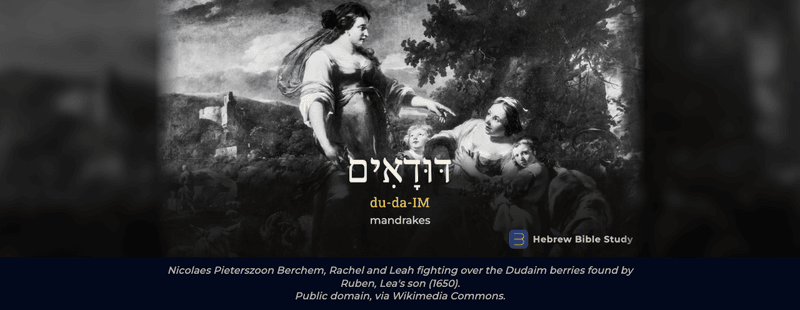
Reuben finds mandrakes in the field.
Rashi names a different plant.
Read Genesis 30:14 in the free Hebrew Bible app: Hebrew audio, JPS English, dictionary and Rashi. Read Genesis 30:14 in Hebrew with audio, dictionary and Rashi
Rachel has asked Jacob for children in the plainest words: "Give me children, or else I die" (Genesis 30:1). Thirteen verses later Leah's firstborn, Reuben, comes in from the field in the wheat harvest with a plant for his mother. Most translations, the app's JPS 1917 text among them, call it mandrakes. Rashi, the eleventh-century commentator, gives the plant another name; in the app his words open Ramban's note beside the verse.
And Reuben went in the days of wheat harvest, and found mandrakes in the field, and brought them unto his mother Leah. Then Rachel said to Leah: ‘Give me, I pray thee, of thy son’s mandrakes.’
וַיִּמְצָא דוּדָאִים בַּשָּׂדֶה
va-yim-TZA du-da-IM ba-sa-DEH
and found mandrakes in the field
Dudaim is the Hebrew, and its readers have never agreed on the plant. Rashi: "דודאים are violets: it is a plant. In Arabic it is called Jasmin." Rashbam, his grandson, reads the fig, "flowers of the fig tree". Ramban doubts Rashi's violets on the calendar, "their season is not in the days of the wheat", and goes back to the ancient Aramaic translation, Onkelos, which has yavruchin, the mandrake; Ibn Ezra, whom he quotes, adds of the plants that "They resemble the human form".
The dictionary in the app, Brown-Driver-Briggs, goes with Onkelos. Its entry is headed mandrake, and the printed Brown-Driver-Briggs entry lists every place the word stands: Genesis 30:14 twice, 30:15 twice, 30:16 once, and once more in the Song of Songs. Six in the whole Hebrew Bible, five of them in these three verses. Its last line turns a look-alike away: dudaei as "vessels, baskets" is another word, dud, a basket, the dudaei of Jeremiah 24:1, "two baskets of figs". Rashbam's note points to that verse.
What Rachel wanted the plants for, the verse does not say. Leah's answer treats them as a prize: "Is it a small matter that thou hast taken away my husband? and wouldest thou take away my son’s mandrakes also?" (Genesis 30:15), and Rachel pays for them with Jacob's evening: he is to stay with Leah that night. Radak reports the common belief that the plant helps a woman conceive and refuses it: it "is not based on fact", since Rachel took the plants and did not conceive then, while Leah conceived because "God hearkened unto Leah" (Genesis 30:17). Five verses on, Rachel's turn comes with the same words: "And God remembered Rachel" (Genesis 30:22). The text credits the plant nowhere.
Where the word goes next
The sixth place is the Song of Songs, where the word stands beside its family. "The mandrakes give forth fragrance," the verse begins, and it ends "O my beloved" (Song of Songs 7:14). Mandrakes is dudaim; beloved is dodi. The app's Dictionary files both under the same three letters, ד-ו-ד, and the printed Brown-Driver-Briggs entry for the plant adds "as love-producing". Ramban records the same reading: scholars who derive the name from "the time of ‘dodim’ (love)" in Ezekiel 16:8.
Rashi, who saw violets in Genesis, sees neither in the Song. There he reads dudaim as Jeremiah's baskets, "The baskets emit fragrance. The baskets of the good and the bad figs", and makes the bad figs the sinners of Israel, who now give off fragrance too. One commentator, one spelling: a plant in Genesis, Temple baskets in the Song. His first note on Reuben's verse is about the boy: harvest time, yet he "brought home only ownerless things".
See it in the app
In the app, open Genesis 30:14, tap the verse and choose Resources: Ramban's note, which opens by quoting Rashi's violets, and Rashbam's fig blossoms are free in the Commentary tab; Radak's note is further down the same list, for subscribers. For the word itself, open Song of Songs 7:14: its first word, hadudaim, "The mandrakes", is free in the Dictionary tab with the app's gloss, the lemma dudai, the letters ד-ו-ד and the Brown-Driver-Briggs line. And from the Questions tab you can ask Rabbi Ari about the verse; he answers with sources for study.
This week's episode of The Story in the Original follows Jacob north to the night of the dream: What Is Jacob's Ladder in the Bible? The Hebrew Answer.
Rashi's violets or Onkelos' mandrakes: which plant did Reuben carry home?
Read Genesis 30:14 in the free Hebrew Bible app: Hebrew audio, JPS English, dictionary and Rashi. Read Genesis 30:14 in Hebrew with audio, dictionary and Rashi
Verses in the 1917 Jewish Publication Society translation; Rashi on Genesis in the English of M. Rosenbaum and A. M. Silbermann (1929-1934); Ramban, Rashbam, Radak and Rashi on the Song of Songs in the English the app serves, as the Hebrew Bible app shows them. Dictionary: Brown-Driver-Briggs, as the app serves it.
Image: Nicolaes Pieterszoon Berchem, Rachel and Leah fighting over the Dudaim berries found by Ruben, Lea's son (1650). Public domain, via Wikimedia Commons.