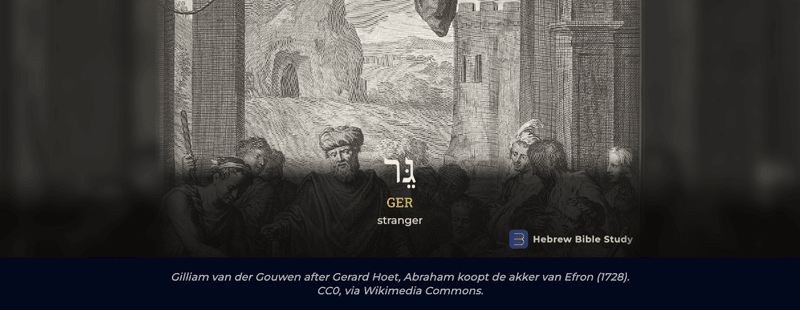
“A stranger and a sojourner,” Abraham says.
Only the stranger pays.
Read Genesis 23:4 in the free Hebrew Bible app: Hebrew audio, JPS English, dictionary and Rashi. Read Genesis 23:4 in Hebrew with audio, dictionary and Rashi
Sarah has died at Hebron. Abraham, who has lived in Canaan for more than sixty years, asks the children of Heth for a grave. He introduces himself with two Hebrew words, and before the chapter ends he pays four hundred shekels of silver for a field with a cave in it:
I am a stranger and a sojourner with you: give me a possession of a burying-place with you, that I may bury my dead out of my sight.
גֵּר־וְתוֹשָׁב אָנֹכִי עִמָּכֶם
GER ve-to-SHAV a-no-KHI i-ma-KHEM
a stranger and a sojourner am I with you
Ger, the first word, is the newcomer. Brown-Driver-Briggs, the lexicon behind the app's dictionary, counts it ninety-two times and, in its full entry, defines it as a sojourner, "temporary dweller, new-comer (no inherited rights)". Toshav, the second, is built on yashav, to sit or dwell. Most English translations keep both words on the outside, "a foreigner and stranger" or "a sojourner and foreigner", and so does Brown-Driver-Briggs, for which toshav here has "only a temporary tenure". The 1917 Jewish Publication Society translation, the English in the app, gives toshav two faces: a sojourner here, and in the law of the land, "for ye are strangers and settlers with Me" (Leviticus 25:23).
Rashi, the eleventh-century commentator the app shows beside the verse, hears the second word the way the JPS renders it in Leviticus, as a settler. His English translators head the comment "I AM A STRANGER AND A SETTLER WITH YOU", and he explains: "A stranger having come from another land, but I have settled down amongst you." Ger says where Abraham came from. Toshav says that he stayed.
Then Rashi brings a second reading, from the Midrash (Genesis Rabbah 58:6), and the two words become two ways to hold the land: "if you agree to sell me the land then I will regard myself as a stranger and will pay for it, but if not, I shall claim it as a settler and will take it as my legal right". The right is the promise Abraham heard when he first came into Canaan: "Unto thy seed will I give this land" (Genesis 12:7). A stranger pays. A settler claims.
The Hittites will not even call him a stranger: "Thou art a mighty prince among us" (Genesis 23:6). Ephron offers the field as a gift. Abraham pays anyway: "I will give the price of the field; take it of me" (Genesis 23:13). He weighs out "four hundred shekels of silver, current money with the merchant" (Genesis 23:16).
Where the word goes next
The word stays in the family. Moses names his son Gershom and explains the name: "I have been a stranger in a strange land" (Exodus 2:22). And the Torah turns the memory into a law about other people: "thou shalt love him as thyself; for ye were strangers in the land of Egypt" (Leviticus 19:34).
The field also answers an older promise: "the land of thy sojournings, all the land of Canaan, for an everlasting possession" (Genesis 17:8). Sojournings, megurim, comes from gur, the verb behind ger, and possession is achuzah, the word Abraham uses at Hebron. Chapter 23 ends with the field and the cave "made sure unto Abraham for a possession of a burying-place" (Genesis 23:20). In Rashi's second reading he could have claimed it as a settler. He paid for it as a stranger.
See it in the app
In the app, open Genesis 23:4, tap the verse and choose Resources, then the Dictionary tab: its first word, ger, is free there, with the app's gloss and the Brown-Driver-Briggs line for it. Rashi's two readings are the first box in the Commentary tab on the same verse. And from the Questions tab you can ask Rabbi Ari about the verse; he answers with sources for study.
This week's episode of The Story in the Original waits by the well with Rebekah, the bride Abraham's servant finds for Isaac: How Isaac Met Rebekah, in the Hebrew.
Stranger or settler: which word fits Abraham at Hebron?
Read Genesis 23:4 in the free Hebrew Bible app: Hebrew audio, JPS English, dictionary and Rashi. Read Genesis 23:4 in Hebrew with audio, dictionary and Rashi
Verses in the 1917 Jewish Publication Society translation and Rashi in the English of M. Rosenbaum and A. M. Silbermann (1929-1934), both public domain, as the Hebrew Bible app shows them. Dictionary: Brown-Driver-Briggs, as the app serves it.
Image: Gilliam van der Gouwen after Gerard Hoet, Abraham koopt de akker van Efron (1728). CC0, via Wikimedia Commons.