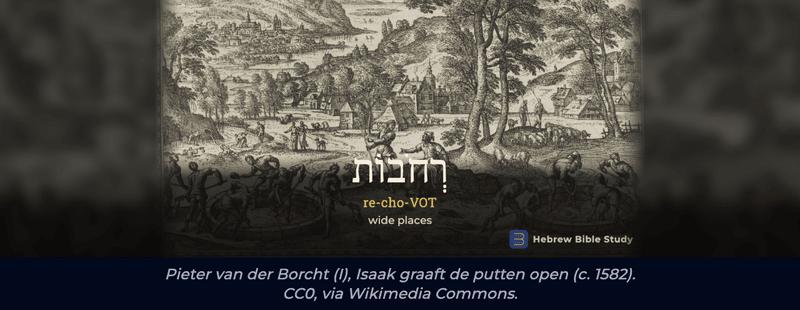
Isaac calls the third well Rehoboth.
His reason is the same word.
Read Genesis 26:22 in the free Hebrew Bible app: Hebrew audio, JPS English, dictionary and Rashi. Read Genesis 26:22 in Hebrew with audio, dictionary and Rashi
A famine has sent Isaac to Gerar, among the Philistines. He digs his father's stopped wells open again (Genesis 26:18), his servants strike living water, and the herdsmen of Gerar claim it. A second well is fought over too. The third well he names Rehoboth, and the verse gives his reason in his own words:
And he removed from thence, and digged another well; and for that they strove not. And he called the name of it Rehoboth; and he said: ‘For now the LORD hath made room for us, and we shall be fruitful in the land.’
וַיִּקְרָא שְׁמָהּ רְחֹבוֹת
va-yik-RA she-MAH re-cho-VOT
and he called the name of it Rehoboth
Rehoboth, rechovot, is a Hebrew plural: wide places. Its singular, rechov, is the open square of a town. When Lot's visitors refuse his roof they say "we will abide in the broad place all night" (Genesis 19:2), and the word is the same. Isaac's reason uses the verb of that family: hirchiv, "hath made room". Most English translations keep Rehoboth as a name and translate only the reason, so the echo is lost. In the Hebrew the name says what the reason says. Brown-Driver-Briggs, the lexicon behind the app's dictionary, heads the verb rachav "be or grow, wide, large" and gives its causative form two senses: make large, enlarge.
The other two wells have names that are words as well. Rashi, the eleventh-century commentator the app shows beside the verse, glosses the first, Esek, as dispute; the verse itself adds "because they contended with him" (Genesis 26:20). For the second, Sitnah, Rashi gives an Old French word, and his English translators write hindrance (Genesis 26:21); Radak, beside him, hears the word satan in it, the accuser. Dispute, hindrance, wide places: the three names tell the chapter in three words. Esek the verse explains, Sitnah it leaves bare, and Rehoboth Isaac explains himself, with the verb of its own root.
On the Rehoboth verse Rashi has one note, on the last words. "We shall be fruitful in the land", ufarinu, he reads with the Aramaic Targum as a future: and we shall increase in the land. The room comes first; the growth is still ahead. Radak, the medieval grammarian in the app's Commentary tab, adds why the well got its name: to tell those who came after "that the ownership of this well had never been disputed".
Where the word goes next
The root keeps its shape elsewhere. In Psalm 4:2 David calls on the God who "didst set me free when I was in distress"; the Hebrew says batzar hirchavta li, in the narrow place You made room for me, Isaac's verb again. Psalm 118:5 answers the strait, metzar, with the broad place, merchav: "He answered me with great enlargement". And Isaiah 54:2 opens with the same verb as a command, harchivi: "Enlarge the place of thy tent".
The name travelled too. The Torah also knows a Rehoboth-ir near Nineveh (Genesis 10:11) and a Rehoboth by the River, home of an Edomite king (Genesis 36:37). In the 1640s the Puritan minister Samuel Newman named a new town, now in Massachusetts, Rehoboth, from this verse, and a beach town in Delaware carries the name today. The chapter moves on to Beer-sheba, where Abimelech comes to make peace; the same day Isaac's servants find water, and he names the fourth well Shibah, which Rashi reads "in allusion to the Covenant" sworn that morning (Genesis 26:33).
See it in the app
In the app, open Genesis 26:22, tap the verse and choose Resources: Rashi's note on ufarinu and Radak's note on the name are in the Commentary tab. For the root, open Isaiah 54:2: its first word, harchivi, "Enlarge", is Isaac's verb, free in the Dictionary tab with the app's gloss, the root rachav and the Brown-Driver-Briggs line. And from the Questions tab you can ask Rabbi Ari about the verse; he answers with sources for study.
This week's episode of The Story in the Original follows Jacob and Esau from the womb to their blind father's tent: Why Did Jacob Steal Esau's Blessing? The Hebrew Answer.
Dispute, hindrance, wide places: which of Isaac's three wells tells the chapter best?
Read Genesis 26:22 in the free Hebrew Bible app: Hebrew audio, JPS English, dictionary and Rashi. Read Genesis 26:22 in Hebrew with audio, dictionary and Rashi
Verses in the 1917 Jewish Publication Society translation, Rashi in the English of M. Rosenbaum and A. M. Silbermann (1929-1934) and Radak in the English the app serves, as the Hebrew Bible app shows them. Dictionary: Brown-Driver-Briggs, as the app serves it.
Image: Pieter van der Borcht (I), Isaak graaft de putten open (c. 1582). CC0, via Wikimedia Commons.