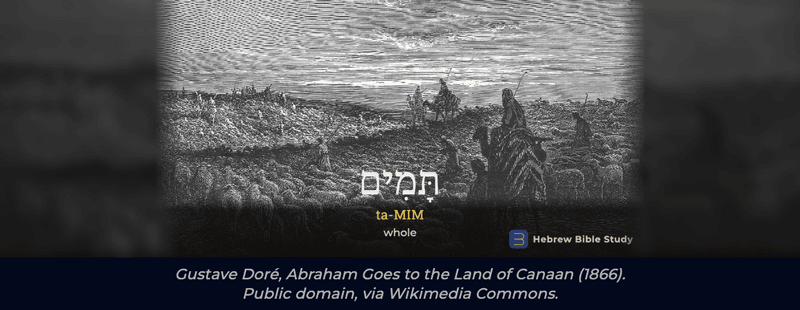
God told Abraham to be perfect.
The Hebrew is a word of the altar.
Read Genesis 17:1 in the free Hebrew Bible app: Hebrew audio, JPS English, dictionary and Rashi. Read Genesis 17:1 in Hebrew with audio, dictionary and Rashi
Most English translations end Genesis 17:1 with "be blameless"; the King James Version has "be thou perfect". The Hebrew word, tamim, is the one the Torah uses for an offering brought to the altar: nothing missing, nothing damaged (Leviticus 22:21). The 1917 Jewish Publication Society translation, the English in our app, chose a stranger word:
I am God Almighty; walk before Me, and be thou wholehearted.
הִתְהַלֵּךְ לְפָנַי וֶהְיֵה תָמִים
hit-ha-LEKH le-fa-NAI veh-YEH ta-MIM
walk before Me, and be tamim
Tamim comes from a root that means to be finished, complete, whole. The dictionary in the app (Brown-Driver-Briggs) counts the word ninety-one times in the Hebrew Bible. Whole, as in a whole day or a whole year (Joshua 10:13, Leviticus 25:30). Sound, which is where most of the ninety-one fall: the lamb for Passover must be tamim, "without blemish" (Exodus 12:5), and the word keeps that job about forty more times in the Torah's laws of offerings. Of God's way and God's teaching: "The law of the LORD is perfect, restoring the soul" (Psalm 19:8; 19:7 in most English Bibles). And of people. In the whole Torah, only three times. Noah: "a man righteous and wholehearted; Noah walked with God" (Genesis 6:9). Abraham, here. And all of Israel, once: "Thou shalt be whole-hearted with the LORD thy God" (Deuteronomy 18:13).
So the altar is the key to the word. An offering is tamim when nothing is missing and nothing is damaged; Leviticus 22:21 says it outright: it must be tamim, "there shall be no blemish therein". The word describes a condition of wholeness, and the Torah says it of a person three times. When it says something like it about Jacob, it uses a shorter word from the same root, ish tam, and JPS leaves wholeness behind entirely: "Jacob was a quiet man, dwelling in tents" (Genesis 25:27). Job gets the same short word: "that man was whole-hearted and upright" (Job 1:1). In none of these verses does JPS call a person perfect.
Rashi, the eleventh-century commentator the app shows beside the verse, reads it as a second command on top of "walk before Me": "be whole-hearted in all the trials I impose upon you." Stay whole through every test. That is a different demand from flawlessness, and it is one a ninety-nine-year-old man can hear. Rashi also brings the Midrash: this is the chapter of the covenant of circumcision, and in that reading the blemish the word has in view is the one the covenant removes.
Something you do on the move
Notice too what the word is attached to, both times the Torah attaches it to a person in Genesis. Noah "walked with God" and was tamim. Abraham is told to "walk before Me" and be tamim. Rashi, following the Midrash, hears on Noah's verse the difference between with and before: Noah "needed God's support to uphold him in righteousness"; Abraham "drew his moral strength from himself and walked in his righteousness by his own effort". Wholeness here is something you do on the move.
See it in the app
In the app, open Genesis 17:1: Rashi opens the Commentary tab, free; his comment on "be perfect" is further down the list (tap Show More). For the dictionary, open Exodus 12:5. Tamim is its second word; tap it and the Dictionary tab shows the Brown-Driver-Briggs entry, the Hebrew with its transliteration beside it, the five senses and the count of ninety-one.
This week's episode of The Story in the Original asks the question that leads here, why God chose Abraham at all: Why Did God Choose Abraham? The Hebrew Answer.
Which English word comes closest: perfect, blameless, or whole?
Read Genesis 17:1 in the free Hebrew Bible app: Hebrew audio, JPS English, dictionary and Rashi. Read Genesis 17:1 in Hebrew with audio, dictionary and Rashi
Verses in the 1917 Jewish Publication Society translation and Rashi in the English of M. Rosenbaum and A. M. Silbermann (1929-1934), both public domain, as the Hebrew Bible app shows them. Dictionary: Brown-Driver-Briggs, as the app serves it.
Image: Gustave Doré, Abraham Goes to the Land of Canaan (1866). Public domain, via Wikimedia Commons.