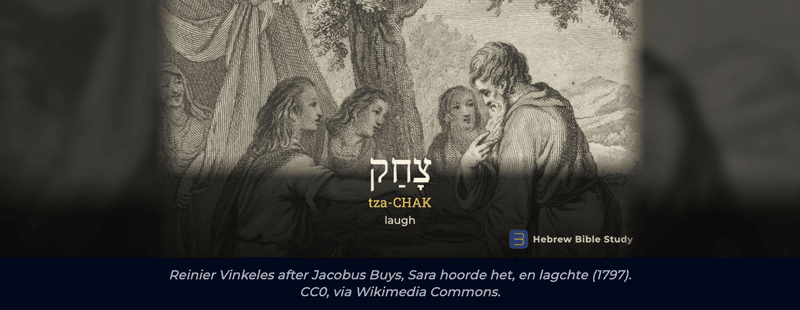
Abraham laughed. Sarah laughed.
Only Sarah's laugh was questioned.
Read Genesis 18:12 in the free Hebrew Bible app: Hebrew audio, JPS English, dictionary and Rashi. Read Genesis 18:12 in Hebrew with audio, dictionary and Rashi
Abraham laughed first. When God promised him a son by Sarah, "Abraham fell upon his face, and laughed" (Genesis 17:17). One chapter later three visitors come to the tent, the promise is repeated, and Sarah, listening at the tent door, does the same:
And Sarah laughed within herself, saying: ‘After I am waxed old shall I have pleasure, my lord being old also?’
וַתִּצְחַק שָׂרָה בְּקִרְבָּהּ
va-titz-CHAK sa-RAH be-kir-BAH
and Sarah laughed within herself
Only Sarah's laugh is questioned. "Wherefore did Sarah laugh", God asks Abraham (Genesis 18:13). She denies it, "I laughed not", and the answer is three Hebrew words: "Nay; but thou didst laugh" (Genesis 18:15). About Abraham's laugh a chapter earlier, the Torah asks nothing. The verb is the same in both verses: tzachak, to laugh.
In this spelling, with the letter tsadi, the verb appears thirteen times in the Hebrew Bible (Brown-Driver-Briggs, the dictionary in the app), and eleven of them are in Genesis. Its simple form is plain laughter, and in chapter 18 it comes four times, every time about Sarah. Its intensive form moves away from laughing. Lot warns his sons-in-law that the city will be destroyed, "But he seemed unto his sons-in-law as one that jested" (Genesis 19:14). Sarah sees Ishmael "making sport" (Genesis 21:9). Potiphar's wife says Joseph was brought in "to mock us" (Genesis 39:14). And Abimelech, king of the Philistines, looks out of a window and sees that "Isaac was sporting with Rebekah his wife" (Genesis 26:8), which is how he learns she is his wife.
Rashi, the eleventh-century commentator the app shows beside the verse, explains the difference between the two laughs through Onkelos, the ancient Aramaic translation of the Torah. Onkelos renders Abraham's laugh with a word that signifies joy, and Sarah's with a word for laughter. Rashi draws the conclusion: Abraham "had faith and rejoiced", and Sarah "had no faith and sneered". Two laughs that sound the same in Hebrew, read as opposites.
Rashi does not leave Sarah there. On her laugh within herself, he says she was thinking of her own body: "Is it possible that this womb shall bear a child". And when God repeats her words to Abraham, they change. She had said "my lord being old also"; God reports her as saying "who am old". Scripture, says Rashi, "alters them for the sake of peace". Ramban, whose commentary the app also carries, asks how "the righteous prophetess" could doubt, and answers for her in another way: Sarah did not know the three visitors were angels, so what she heard was a promise from strangers.
The laugh that became a name
Then the verb becomes a name. God had already said it to Abraham, "thou shalt call his name Isaac" (Genesis 17:19), and Rashi explains the name: "with reference to his laughter." Yitzchak is a form of the verb itself; Brown-Driver-Briggs glosses the name "he laugheth".
And Sarah, who had said "I laughed not", says the word herself when the child is born: "God hath made laughter for me; every one that heareth will laugh on account of me" (Genesis 21:6). The laugh that was questioned at the tent door is now something God made, and Onkelos, who gave her first laugh the word for laughter, gives this one the word for joy, the word he gave Abraham. Rashi reads her last words as "will rejoice on my account" and brings the Midrash: "Many barren women were remembered together with her".
See it in the app
In the app, open Genesis 18:12 and tap its first word, vattitzchak. The Dictionary tab shows the root tzachak with the Brown-Driver-Briggs entry, free: laugh in the simple form, jest and sport, play in the intensive one. Rashi on Abraham's laugh, where he sets Onkelos's two renderings side by side, is the first box in the Commentary tab on Genesis 17:17. And from the Questions tab you can ask Rabbi Ari about the verse; he answers with sources for study.
This week's episode of The Story in the Original climbs the mountain with Abraham and the son whose name is a laugh: The binding of Isaac, in the Hebrew.
Abraham's laugh or Sarah's: which one sounds more human?
Read Genesis 18:12 in the free Hebrew Bible app: Hebrew audio, JPS English, dictionary and Rashi. Read Genesis 18:12 in Hebrew with audio, dictionary and Rashi
Verses in the 1917 Jewish Publication Society translation and Rashi in the English of M. Rosenbaum and A. M. Silbermann (1929-1934), both public domain, as the Hebrew Bible app shows them. Dictionary: Brown-Driver-Briggs, as the app serves it.
Image: Reinier Vinkeles after Jacobus Buys, Sara hoorde het, en lagchte (1797). CC0, via Wikimedia Commons.