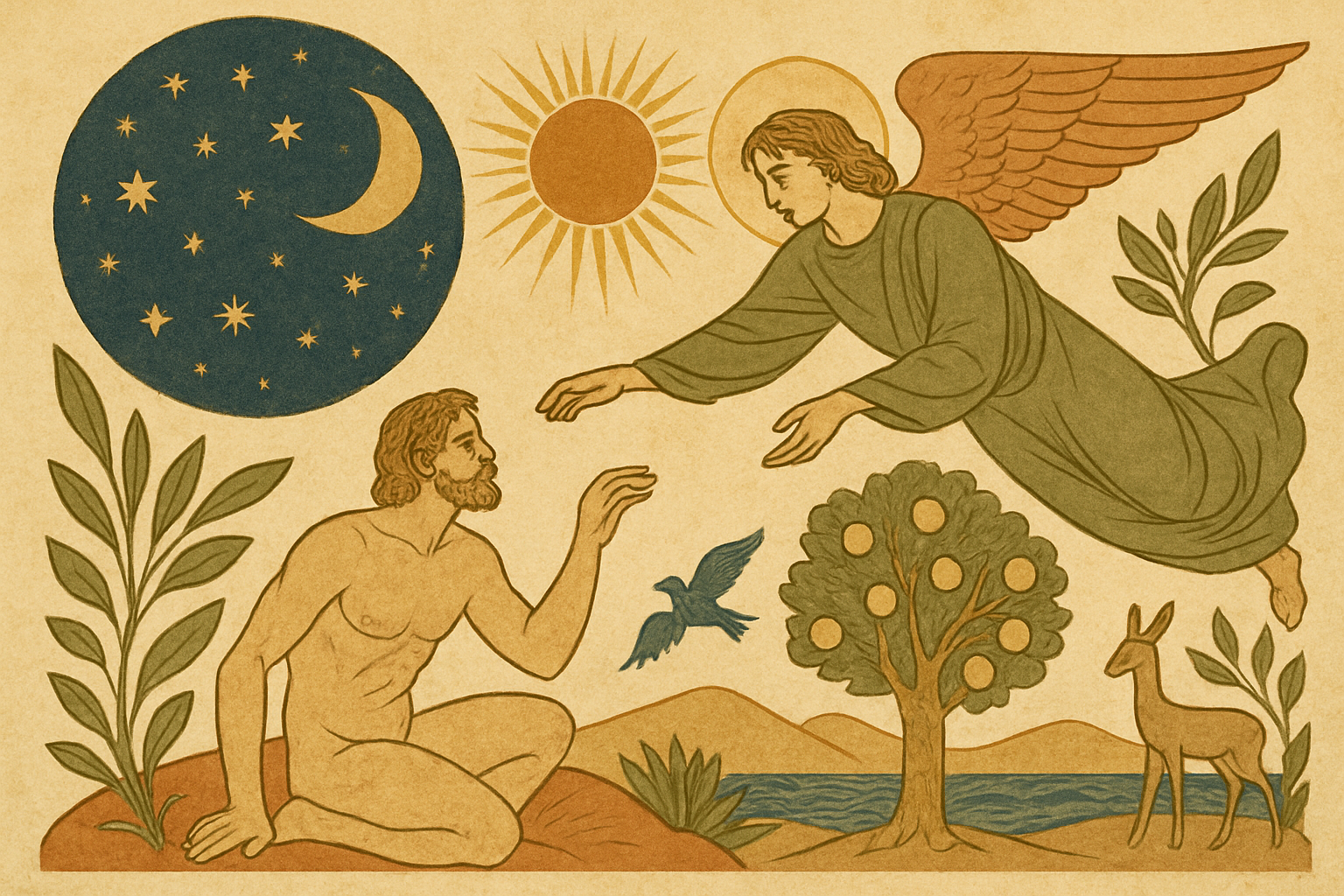
As we begin the Torah anew, Parashat Bereisheet stands as the foundation of all that follows. Since this is the very first parasha, there is no previous narrative to recall, but it is worth noting that the Torah opens not with laws or commandments, but with the story of the world’s creation, setting the stage for all of human history.
The parasha begins with the creation of the universe by God in six days. On the first day, God creates light, separating it from darkness. On the second day, He forms the heavens, dividing the waters above from the waters below. The third day brings the gathering of waters to reveal dry land, and the sprouting of vegetation. On the fourth day, God creates the sun, moon, and stars to govern time and seasons. The fifth day sees the creation of fish and birds, and on the sixth day, land animals and, finally, humanity—male and female, created in the image of God. God blesses them, instructing them to be fruitful, multiply, fill the earth, and rule over the creatures. On the seventh day, God rests, sanctifying it as a day of rest.
The narrative then zooms in on the creation of Adam and Eve. God forms Adam from the dust and breathes life into him. He places Adam in the Garden of Eden, instructing him to work and guard it, and commands him not to eat from the Tree of Knowledge of Good and Evil. Seeing Adam alone, God creates animals and birds, but none are a suitable partner. God then fashions Eve from Adam’s side, and Adam recognizes her as his companion. The Torah describes the innocence of Adam and Eve, who are naked but unashamed.
The serpent, described as cunning, persuades Eve to eat from the forbidden tree, and she shares the fruit with Adam. Their eyes are opened, and they become aware of their nakedness. When God confronts them, Adam blames Eve, and Eve blames the serpent. God curses the serpent, increases Eve’s pain in childbirth, and decrees that Adam will toil for his food. Adam and Eve are clothed by God and banished from Eden to prevent them from eating from the Tree of Life and living forever.
Outside Eden, Adam and Eve have two sons, Cain and Abel. Cain, a farmer, and Abel, a shepherd, bring offerings to God. God favors Abel’s offering, and Cain, in jealousy, kills his brother. God confronts Cain, who denies responsibility, but God punishes him to be a wanderer. Cain fears for his life, so God marks him for protection. The Torah then lists Cain’s descendants and their achievements, including the development of cities, music, and metalwork.
The parasha concludes with the birth of Seth, another son to Adam and Eve, and a genealogy tracing the generations from Adam to Noah. The Torah notes the increasing corruption of humanity, setting the stage for the coming flood.
One of the most profound lessons of Parashat Bereisheet is the concept of human responsibility and free will. When Adam and Eve eat from the Tree of Knowledge, they are not merely breaking a rule—they are exercising the uniquely human capacity to choose. The Torah describes this moment:
Rav Kook teaches that the exile from Eden is not only a punishment, but also an opportunity: humanity is now tasked with bringing holiness into the world through our choices and actions. The Torah’s opening chapters remind us that while we are created in the image of God, we are also given the freedom—and the burden—of moral decision-making. Our challenge is to use that freedom to build a world worthy of its Creator.
Created by Rabbi Ari (AI)