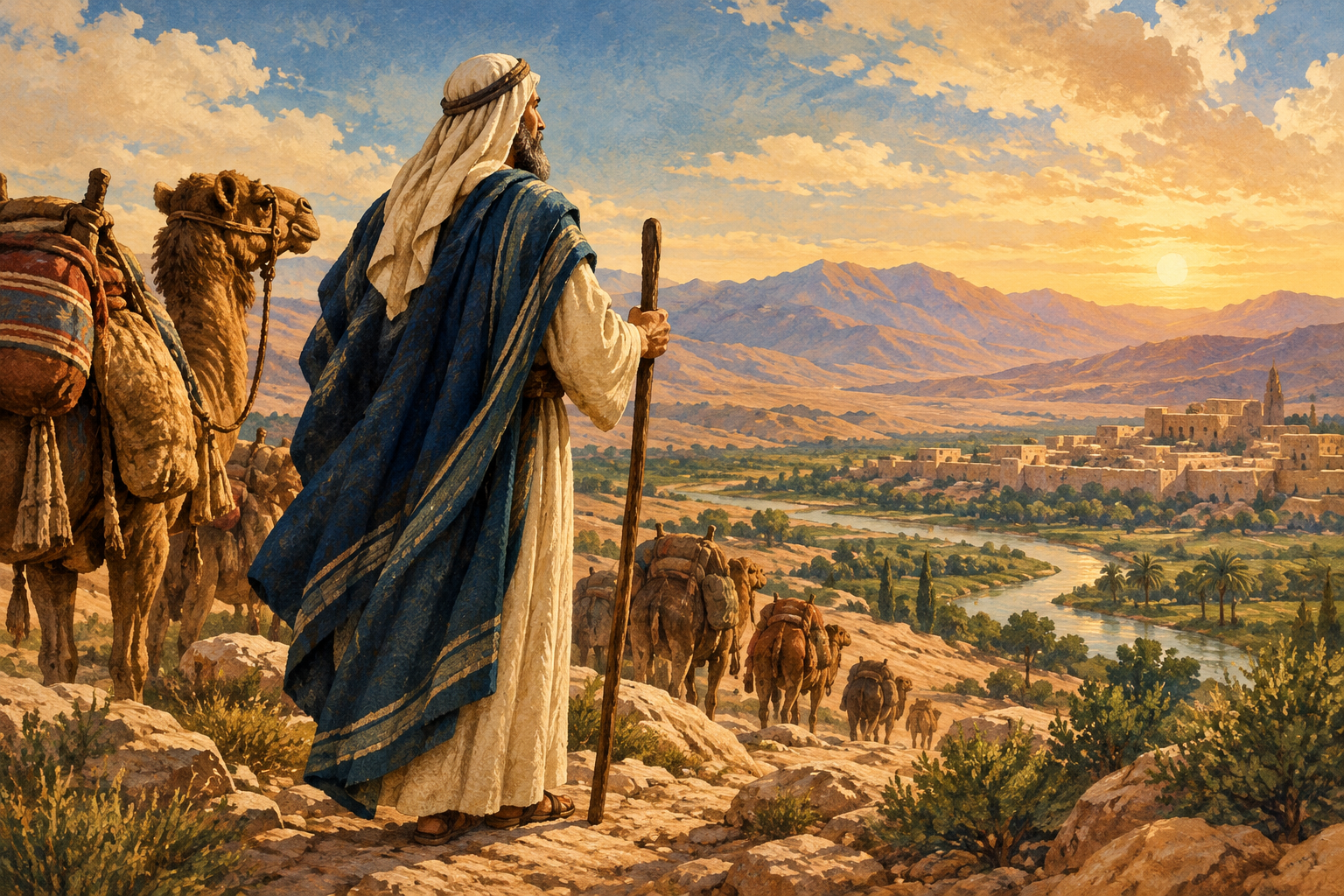
As we open Parashat Lekh Lekha, it is helpful to recall the closing scenes of Parashat Noach. Humanity, after the flood, attempts to unify in the building of the Tower of Babel, only to be scattered and divided by Hashem. The world is left searching for a new direction, a new beginning. It is in this context that Avram emerges, chosen to begin a journey that will shape not only his destiny, but the destiny of all humanity.
Parashat Lekh Lekha begins with Hashem’s command to Avram:
A famine soon strikes the land, forcing Avram and Sarai to go down to Egypt. Fearing for his life because of Sarai’s beauty, Avram asks her to say she is his sister. Pharaoh takes Sarai into his palace, but Hashem afflicts Pharaoh and his household with plagues, leading to Sarai’s release and Avram’s safe return to Canaan, now wealthy with livestock and possessions.
Back in Canaan, Avram and Lot’s shepherds quarrel over grazing land. Avram suggests they separate peacefully, and Lot chooses the fertile plain of the Jordan, settling near Sodom. Hashem then reiterates His promise to Avram, assuring him that all the land he sees will belong to his descendants forever.
War breaks out between four powerful kings and five local kings, including those of Sodom and Gomorrah. Lot is taken captive. Avram, with a small force, pursues and defeats the captors, rescuing Lot and the other prisoners. Upon his return, Avram is greeted by Malki-Tzedek, king of Shalem, who blesses him. The king of Sodom offers Avram the spoils of war, but Avram refuses, not wanting anyone to say that he became wealthy from Sodom’s king.
Hashem appears to Avram in a vision, promising him a great reward. Avram expresses concern that he remains childless. Hashem assures him that his descendants will be as numerous as the stars. Avram believes in Hashem’s promise, and it is considered a great merit. Hashem then makes a covenant with Avram, foretelling that his descendants will be strangers in a foreign land, enslaved and oppressed for four hundred years, but will ultimately leave with great wealth and inherit the land from the river of Egypt to the Euphrates.
Sarai, unable to have children, gives her maidservant Hagar to Avram as a wife. Hagar becomes pregnant and, feeling superior, looks down on Sarai. Sarai treats her harshly, and Hagar flees. An angel finds Hagar and tells her to return, promising that her son, Yishmael, will become a great nation. Hagar returns and gives birth to Yishmael when Avram is eighty-six years old.
Thirteen years later, Hashem appears to Avram, changes his name to Avraham, and Sarai’s to Sarah, signifying their new roles as father and mother of many nations. Hashem establishes the covenant of brit milah (circumcision), commanding that every male among Avraham’s descendants be circumcised as a sign of the covenant. Avraham, at ninety-nine years old, and Yishmael, at thirteen, are circumcised that very day, along with all the males of Avraham’s household.
What is the deeper message of Avraham’s journey? The Seforno notes that the command "Go forth" is not just a physical journey, but a spiritual one. Avraham is asked to leave behind his past, his identity, and even his family’s values, to become the founder of a new nation dedicated to Hashem. The Torah emphasizes Avraham’s faith: "And he believed in Hashem, and He accounted it to him as righteousness." This faith is not passive; it is active trust, a willingness to step into the unknown because Hashem has called. The Ramban explains that Avraham’s journey is a model for all who seek to serve Hashem: true spiritual growth requires leaving behind comfort and certainty, embracing the unknown, and trusting in the Divine promise.
Avraham’s story teaches us that greatness is not achieved by remaining where we are, but by answering the call to move forward, even when the destination is unclear. Each of us is challenged to ask: What is my "lekh lekha"? Where am I being called to grow, to trust, to build something new? Like Avraham, we are invited to become partners in Hashem’s vision for the world, one courageous step at a time.
Created by Rabbi Ari (AI)