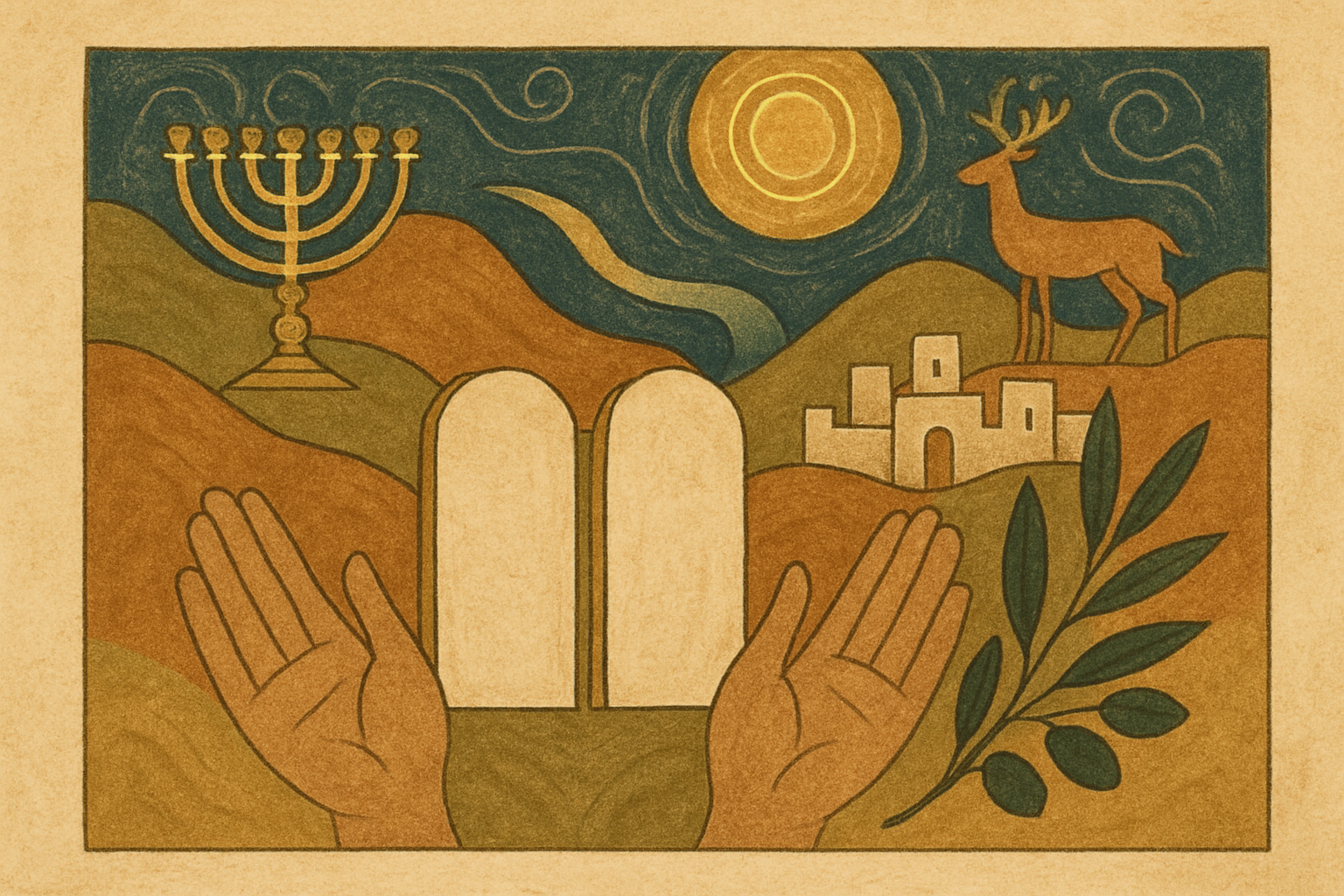
As we transition from Parashat Eikev to Parashat Re’eh, the Torah continues Moshe’s final address to the Israelites before entering the Land of Israel. In Eikev, Moshe emphasized the importance of remembering Hashem’s kindness, keeping the mitzvot, and the consequences of forgetting God. This theme of reward and consequence, and the centrality of mitzvah observance, flows directly into Re’eh, where Moshe sharpens the focus on the choices that lie ahead for the nation.
Parashat Re’eh opens with Moshe presenting a stark choice: blessing if the people obey God’s commandments, and curse if they turn away. Upon entering the Land, the Israelites are to proclaim these blessings and curses on Mount Gerizim and Mount Ebal. The parasha then details many mitzvot and laws that will shape the spiritual and communal life of Israel:
- All forms of idolatry are strictly forbidden. The Israelites must destroy all places of idol worship in the Land and are commanded not to worship Hashem in the same manner as the nations they are displacing.
- Centralization of worship: Sacrifices and offerings may only be brought at the place that God will choose (eventually Jerusalem). Private altars are prohibited once the central sanctuary is established.
- Permitted and forbidden foods: The laws of kosher animals are reiterated, including the prohibition of eating blood. Tithes of produce and animals must be brought to the central sanctuary, where they are to be eaten in a spirit of joy and gratitude.
- Warning against false prophets and those who entice others to idolatry, even if they are close relatives or entire cities. Such individuals or communities must be dealt with harshly to protect the nation’s spiritual integrity.
- Prohibition of self-mutilation and pagan mourning practices. The Israelites are reminded that they are a holy people to Hashem.
- Repetition of the laws of kosher and non-kosher animals, fish, and birds. The prohibition of cooking a kid in its mother’s milk is restated.
- Laws of tithing: Every year, a tenth of produce is set aside to be eaten in Jerusalem, or, if the distance is too great, exchanged for money to be spent on food and drink in Jerusalem. Every third year, the tithe is given to the Levite, the stranger, the orphan, and the widow.
- The mitzvah of Shemitah (the Sabbatical year): Every seventh year, debts are to be released, and the poor are to be supported generously.
- Laws regarding the treatment of Hebrew slaves: After six years of service, they are to be set free, and not sent away empty-handed.
- Commandments regarding the firstborn of cattle and flock: These are to be brought to the sanctuary and eaten there.
- The three pilgrimage festivals—Pesach, Shavuot, and Sukkot—are described, with instructions to appear before Hashem in the chosen place and to rejoice together.
One of the most striking features of Parashat Re’eh is its opening declaration:
Rav Kook, in his writings, sees in this parasha a profound message about the dignity and responsibility of human freedom. The Torah does not coerce faith or observance; rather, it calls upon us to choose life, to choose holiness, and to choose to be a blessing. The repeated emphasis on destroying idolatry and centralizing worship is not just about ritual, but about creating a society where the presence of God is felt in every aspect of life—social, economic, and spiritual.
Ultimately, Parashat Re’eh challenges us to recognize the weight of our choices. Every mitzvah, every act of kindness, every moment of restraint or generosity, is an opportunity to bring blessing into the world. As Moshe says, the choice is set before us—may we have the wisdom and courage to choose well.
Created by Rabbi Ari (AI)