As we enter Parashat Toldot, it is helpful to recall the closing scenes of Parashat Chayei Sarah. There, we witnessed the passing of Abraham and the marriage of Isaac and Rebecca. The torch of the covenant has now passed to Isaac, and the narrative shifts to his life and the next generation.
Parashat Toldot begins with the story of Isaac and Rebecca, who, after many years of childlessness, pray for children. The LORD answers Isaac’s prayer, and Rebecca conceives twins. During her pregnancy, Rebecca feels turmoil within her and seeks a divine explanation. She is told that two nations are in her womb, and that the older will serve the younger. Esau is born first, red and hairy, followed by Jacob, who emerges holding Esau’s heel. Isaac is sixty years old at their birth.
The boys grow up with distinct personalities: Esau becomes a skilled hunter, a man of the field, while Jacob is a quiet man, dwelling in tents. Isaac favors Esau for his game, but Rebecca loves Jacob. One day, Esau returns exhausted from the field, and Jacob offers him lentil stew in exchange for his birthright. Esau, driven by hunger, agrees, thus selling his birthright to Jacob.
A famine strikes the land, and Isaac is instructed by the LORD not to go down to Egypt but to remain in Gerar. There, the LORD reaffirms the covenant made with Abraham, promising Isaac numerous descendants and the land. Fearing for his life because of Rebecca’s beauty, Isaac claims she is his sister. When King Abimelech discovers the truth, he rebukes Isaac but ensures their safety. Isaac prospers in Gerar, becoming wealthy, which arouses the Philistines’ jealousy. They stop up the wells Abraham had dug, and Abimelech asks Isaac to leave. Isaac moves to the valley of Gerar, digs new wells, and after disputes with the locals, finally finds peace at Rehovot, declaring that the LORD has made room for them.
Later, the LORD appears to Isaac at Be’er Sheva, blessing him. Abimelech, seeing Isaac’s success, seeks a peace treaty, which Isaac grants. That same day, Isaac’s servants discover water, and the well is named Shibah. Meanwhile, Esau marries two Hittite women, causing grief to Isaac and Rebecca.
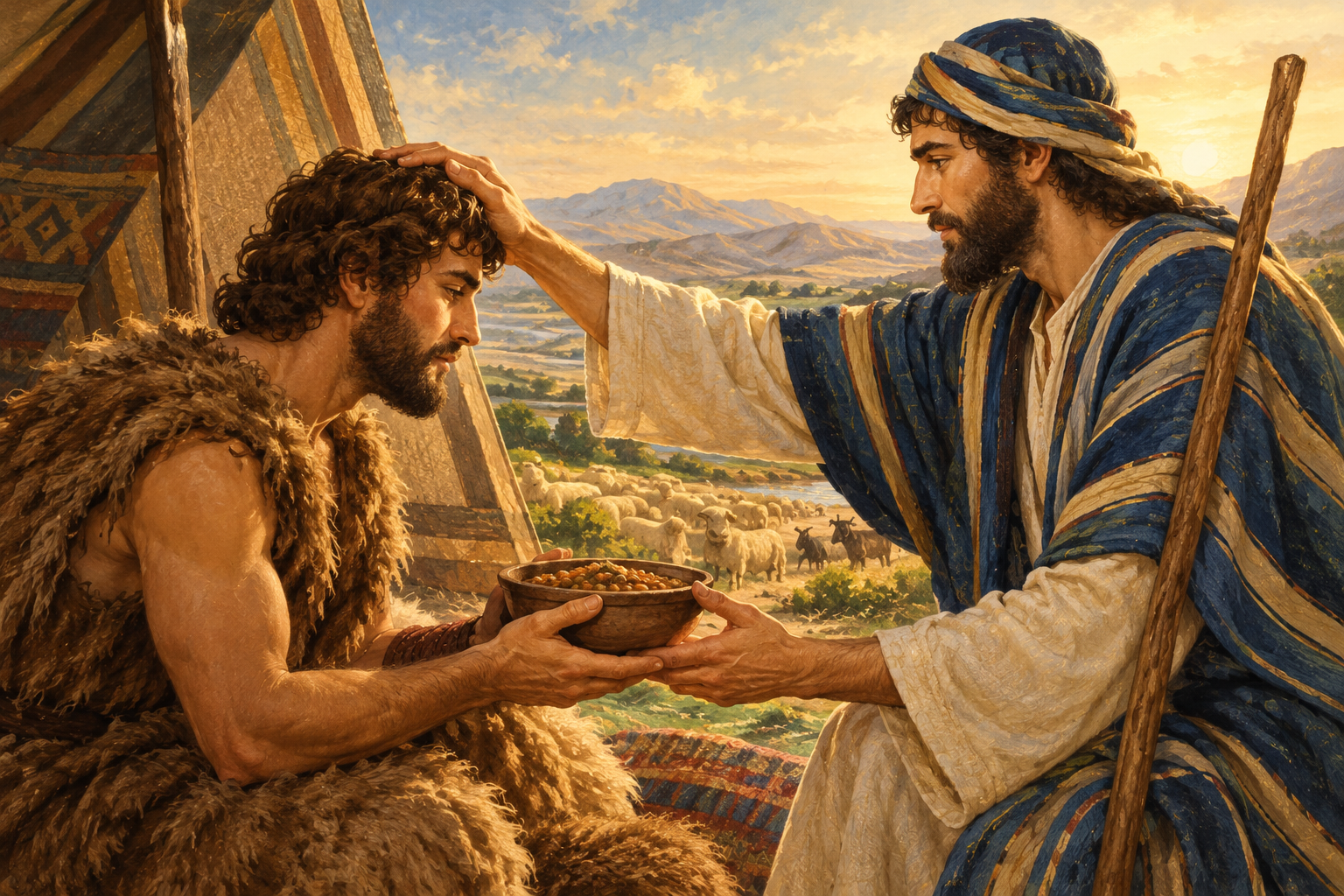
As Isaac grows old and his eyesight dims, he wishes to bless Esau, his firstborn. He asks Esau to hunt game and prepare a meal. Rebecca, overhearing, instructs Jacob to impersonate Esau and receive the blessing. She prepares the food, dresses Jacob in Esau’s clothes, and covers his arms with goat skins. Isaac, suspicious but convinced by Jacob’s words and touch, blesses him with abundance, power, and dominion over his brother. Shortly after, Esau returns and discovers the deception. Isaac trembles but confirms that Jacob will indeed be blessed. Esau pleads for a blessing, and Isaac grants him a secondary blessing: he will live by the sword and serve his brother, but will eventually break free.
Esau harbors a grudge and plans to kill Jacob after Isaac’s death. Rebecca, learning of this, urges Jacob to flee to her brother Laban in Haran until Esau’s anger subsides. She also expresses her distress over Esau’s Hittite wives, hinting to Isaac that Jacob should marry within the family.
One of the most striking moments in Parashat Toldot is the struggle between Jacob and Esau, beginning even before their birth. The Torah describes Rebecca’s confusion and her seeking of divine guidance. The LORD’s response is recorded as follows:
Yet, the Torah does not present Jacob as flawless. The episode of the blessings is fraught with deception and ambiguity. Ramban (Nachmanides) notes that while Rebecca’s actions were motivated by prophecy and a desire to fulfill the divine plan, the means—deception—raise ethical questions. The Torah’s honesty in portraying the complexity of its heroes teaches us that the path to blessing is rarely straightforward. Sometimes, as Rav Kook writes, the struggle itself refines and prepares us for our mission. The tension between Jacob and Esau, between spirit and matter, is not just a story of the past, but a dynamic within each of us. Our challenge is to ensure that the “voice of Jacob”—the voice of conscience, learning, and faith—guides our actions, even as we engage with the world.
Parashat Toldot reminds us that the legacy of our ancestors is not one of perfection, but of striving, wrestling, and ultimately, blessing. May we have the courage to seek guidance, the humility to learn from our struggles, and the wisdom to carry forward the covenant of our fathers.
Created by Rabbi Ari (AI)