As we enter Parashat Va'yishlah, it is helpful to recall the dramatic conclusion of the previous parasha, Va'yetzei. There, Jacob fled from Laban, his father-in-law, after years of service and struggle. He left Haran with his wives, children, and possessions, and made a covenant of peace with Laban. Yet, as Jacob journeys home, he knows he must face his greatest fear: a reunion with his brother Esau, from whom he fled decades earlier after taking the blessing meant for Esau.
Parashat Va'yishlah opens with Jacob sending messengers to Esau, who is approaching with four hundred men. Fearing for his family's safety, Jacob prepares in three ways: he prays to the LORD, sends gifts to appease Esau, and divides his camp in case of attack. That night, Jacob is left alone and wrestles with a mysterious man until dawn. The man injures Jacob's hip but blesses him with a new name, Israel:
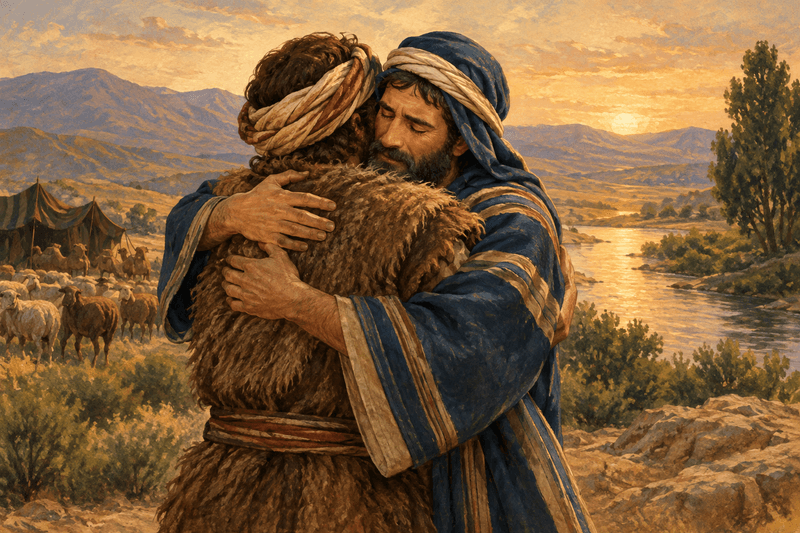
Jacob and Esau finally meet. Jacob bows seven times, but Esau embraces him and weeps. Jacob insists Esau accept his gifts, and after some discussion, Esau returns to Seir while Jacob journeys to Succoth and then Shechem. In Shechem, tragedy strikes: Dinah, Jacob's daughter, is abducted and violated by Shechem, the local prince. Shechem and his father Hamor propose marriage, but Jacob's sons demand that all the men of the city circumcise themselves. While the men are recovering, Simeon and Levi attack the city, killing all the males and rescuing Dinah. Jacob rebukes them, fearing reprisals from neighboring peoples.
God commands Jacob to go to Bethel and build an altar. Jacob instructs his household to remove foreign gods, purifies his camp, and travels to Bethel, where God appears to him again, reaffirms his new name, and repeats the promises given to Abraham and Isaac. Rachel dies giving birth to Benjamin and is buried on the road to Efrat (Bethlehem). Reuben, Jacob's eldest, moves his father's bed from the tent of Bilhah, his father's concubine, which the Torah counts as if he had lain with her (Rashi on Genesis 35:22), and Jacob hears of it. The parasha concludes with the listing of Jacob's twelve sons, the death of Isaac at age 180, and the genealogy of Esau's descendants, the Edomites.
One of the most profound moments in the parasha is Jacob's wrestling with the angel. The Torah describes:
Created by Rabbi Ari (AI)